Teaching kids, not just tracking targets — with data that finally keeps up.

Neurofit gives ABA and IBI providers adaptive cognitive activities, home-and-clinic continuity, and organization-wide visibility — without adding another system your team has to be trained on for hours.

Your file cabinets — and your compliance risk — are growing faster than your team.

Between discrete-trial data sheets, paper binders, and a College-mandated retention window that can stretch a decade past a client's 18th birthday, most ABA and IBI teams are drowning in documentation nobody has time to build.

No visibility into what happens at home

Assigned practice gets sent home in a folder and comes back — or doesn't — with no way to know who actually completed it. Neurofit tracks completion and performance automatically, the same way a school sign-in system shows a parent their child showed up.

Compliance pressure with no system built for it

Regulatory file-retention requirements are only getting longer, and paper binders and disconnected spreadsheets aren't a real answer. A digital record that's automatically organized and retained is no longer optional — it's table stakes.

Software that takes longer to learn than it saves

Most clinical software wasn't built for how BCBAs and RBAs actually work day to day. If a tool takes hours to learn and days to train a team on, it doesn't get used — no matter how good the data is. Neurofit is built to be handed to a new RBT or RBA on day one.

Built around the four things ABA teams tell us actually get used.

1

Assignments your team can actually see through

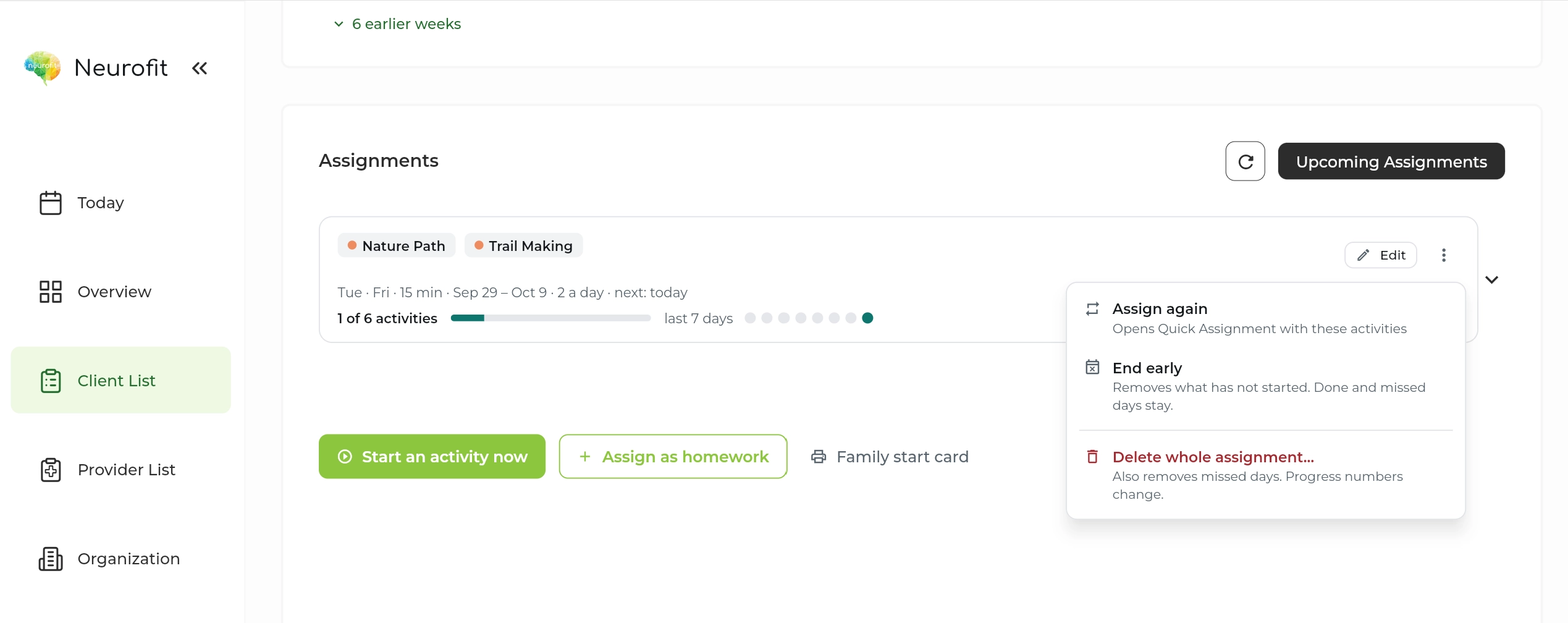
Assign practice activities the same way you'd assign clinical homework — done on a home computer between sessions — and see exactly who completed it, when, and how they performed. No more guessing whether a skill actually got practiced.

2

Built for executive function, attention, and self-regulation

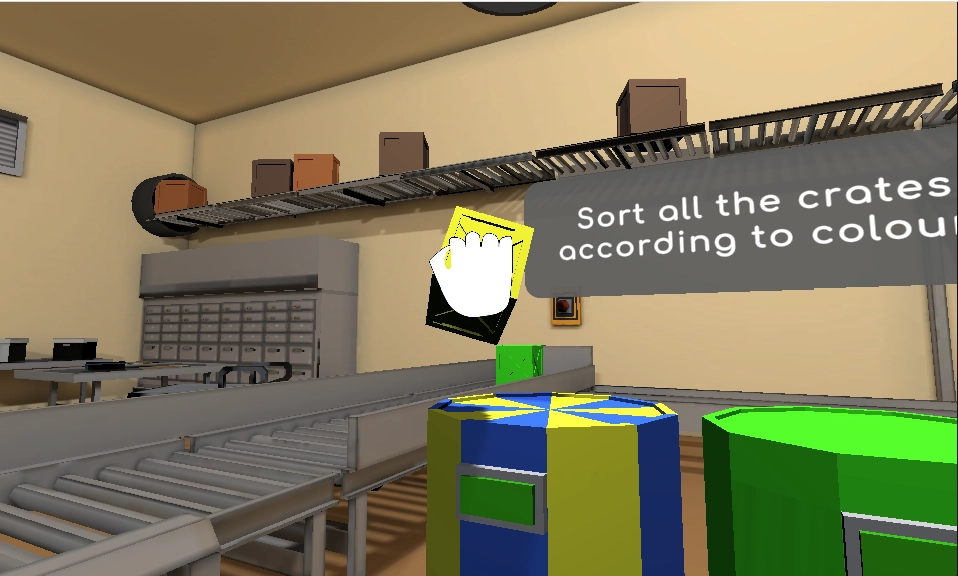
Activities are built around the executive-function, attention, and impulse-control skills that show up across autism and ADHD caseloads — not just isolated drill-and-repeat tasks.

3

Adaptive difficulty that mirrors precision teaching

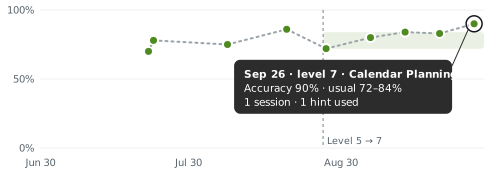
Neurofit's adaptive difficulty engine adjusts in real time based on both accuracy and speed — the same accuracy-plus-fluency principle behind precision teaching. Built-in variability also prevents the compensatory shortcuts kids often find in static paper materials, so what you're measuring is the actual skill, not a workaround.

4

One dashboard for the whole caseload

See every active client, who's on track, who's at risk, and who's responding best — without opening a single individual chart. Built for organization-wide oversight, not just one clinician's caseload.

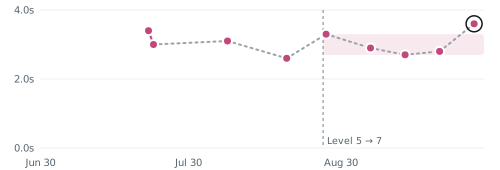
Neurofit clinician dashboard showing caseload overview and daily activity trends

Getting started takes an afternoon, not an onboarding project — create an account, add a client, and assign your first activity, all in one sitting.

Objective performance and how the child actually feels about it — in one view.

Most tools show you accuracy scores. Neurofit also captures how a child felt about the session — because both signals matter for treatment decisions.

Objective Performance

What their brain is doing.

Reaction Time

Response speed across trials

Accuracy

Correct vs. incorrect responses

Processing Speed

Task completion rate over time

Attention

Sustained focus and consistency

Executive Function

Planning, sequencing, cognitive control

Subjective & Behavioral

How they're experiencing it.

Engagement

How actively the client participates

Effort

Self-reported exertion level

Frustration

Difficulty tolerance and emotional response

Mood

Simple emoji self-report, pre/post session

Neurofit dashboard showing a child's self-reported achievement, frustration, perceived difficulty, enjoyment, and effort ratings over time

When accuracy improves but a child's mood ratings drop, the activity may be too hard. When engagement drops but scores hold steady, they may be bored. Both signals are in the dashboard — not just one.

Progress families can actually see — and that shows up outside the clinic.

Because practice happens between sessions, from any home computer, the goal isn't a higher score in the room; it's skills that carry over to the places that matter: home, school, and daily routines. Give families real, quantitative evidence of that progress, not just a verbal update at pickup, with a one-click consolidated report you can share or hand off.

Neurofit consolidated progress report comparing a client's cognitive category performance across the previous and current periods, with one-click PNG and CSV export

What the research shows.

Neurofit's own outcomes data, alongside the published research behind the cognitive principles our activities are built on.

Pediatrics · ASD · Ages 6+

147%
Improvement in Motivation
4 weeks · self-reported · single-case study

Published Research

Computerized training targeting cognitive flexibility has shown measurable gains in children with autism spectrum disorder.
Kenworthy et al., 2014 · Journal of Child Psychology and Psychiatry

Published Research · ADHD

A meta-analysis of randomized controlled trials found computerized cognitive training significantly improved working memory in children with ADHD, with some effects persisting at longer-term follow-up.
Cortese et al., 2023 · Molecular Psychiatry

Improvements are statistically significant (p ≤ 0.05). Pediatric motivation data from a single-case study (ASD, pre-teen). Published research cited above is independent of Neurofit and describes the underlying cognitive training principles our activities are built on, not a direct study of the Neurofit platform.

Common questions from ABA and IBI providers.

No. Neurofit sits alongside your existing assessment/data system — it fills the gap in day-to-day assignment tracking, home-based practice data, and organization-wide oversight that most ABA platforms aren't built for.

Yes. Neurofit is built around adaptive, real-world-relevant activities rather than rigid drill-and-repeat — designed to complement teaching-first, generalization-focused approaches.

You assign each client individually, so during a group session you can open assignments for several clients at the same time and each child's performance is tracked separately under their own profile. There's no shared group score to untangle afterward — every result lands on the right client.

Session and assignment data is retained digitally and organized by client automatically, replacing paper binders and ad hoc spreadsheets as your durable record.

No. Neurofit runs in any modern desktop browser. Clients receive a link, click it, and start — no app store, no installation, no account setup required on their end.

Today, Neurofit runs in a desktop or laptop browser for the best experience — that's where the activities and the clinician dashboard are fully supported. A native tablet and iPad experience is on our roadmap. If tablet access is essential to how your clinic works, tell us on a walkthrough and we'll share where it stands.

Yes. Neurofit is HIPAA-aligned and PIPEDA/PHIPA compliant. Data is stored in Canada and the United States. BAAs are available for enterprise accounts. We take data privacy seriously — your clients' information is never sold or shared with third parties.

The Starter plan is free for up to 5 active clients per month — no trial, no expiration. Pro is $35 CAD per active client per month, with all active clients billed from client 1. An "active client" is one who logs in at least once during a billing period. Inactive clients are never charged. See pricing for details.

Start free — up to 5 active clients.

Sign up in minutes. Assign your first activity. See data you've never had before.